
Point of Sale
Point of Sale
Do Self-Order Kiosks Increase Sales? 4 Features That Decide This
Do Self-Order Kiosks Increase Sales? 4 Features That Decide This
Do Self-Order Kiosks Increase Sales? 4 Features That Decide This
Self-order kiosks can lift order value 14-16%, but only if set up right. The 4 features that decide it, plus the one most operators miss.
Self-order kiosks can lift order value 14-16%, but only if set up right. The 4 features that decide it, plus the one most operators miss.
Written by

Nomni
The ultimate hospo solution
A kiosk doesn't lift sales because it's a touchscreen. It lifts sales because it runs the same upsell on every order, never gets embarrassed, and never gets too slammed to ask. Researchers at the University of Hamburg measured this across real transaction data from 20 restaurants and found that customers spend roughly 14 to 16% more when ordering at a kiosk than at the counter. The lift is real, but only if the kiosk is configured to earn it. Here's what actually moves the number, feature by feature, plus the one most operators still have switched off.
1. Upsell prompts that fire at item and basket level
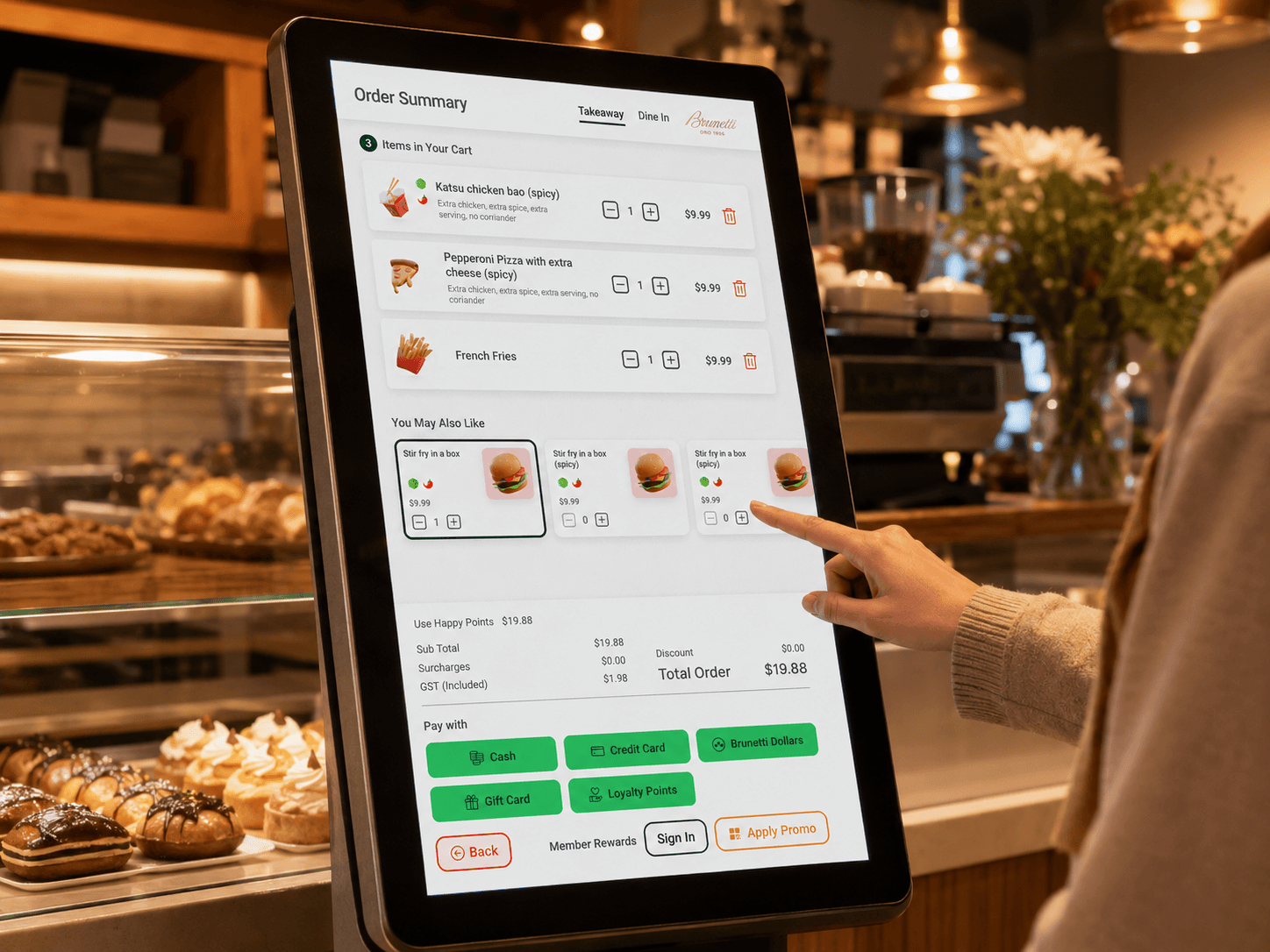
The upsell is where order value actually moves, and the kiosk runs it on every single ticket from a list you control centrally. Here is how it works in practice. You flag the items you want to move as "Popular" in the master POS, switch Upselling on at the self-ordering kiosk, and those items surface as recommendations while the customer orders, with prompts configurable at item and basket stages and a suggestion at checkout before they pay.
That central control is the point. Change what you are pushing this week, whether it is a slow-moving dessert, a new side, or the combo you want to shift, and it updates across every kiosk at once. You are not relying on each unit or each staff member to remember the upsell.
The Hamburg researchers traced the lift to two things working together: the kiosk applies the same cross-sell logic on every order, and customers order more freely when they don't feel watched across a counter. A server skips the upsell when the line is six deep. The kiosk never skips it.
2. One menu that updates across kiosk, POS, and online at once
Change a price, add an item, or launch a promo once, and it pushes to the kiosk, the POS, and online ordering at the same time, with no separate kiosk menu to maintain. Nomni's unified menu management runs the kiosk off the same menu source as every other channel, so nothing drifts out of step with the counter.
Updates land via silent over-the-air push, meaning menus, pricing, promos, and themes change without a site visit or an IT ticket. Real-time inventory sync is often overlooked: when an item runs out, it disappears from the kiosk instantly, so no one orders, pays for, and then gets refunded on a dish you can't make, and no one stalls the line hunting for a sold-out item. More on running this across sites: effortless menu management for multi-venue restaurants.
3. Offline mode, because a stalled kiosk costs you twice
When the venue's internet drops, the kiosk keeps taking orders and, with Nomni Pay, keeps processing payments, then reconciles everything once the connection returns. The reason it can is architectural. The kiosk runs against the in-venue master POS over the local network instead of making a round trip to the cloud for every order, so a dropped uplink doesn't halt service. The connectivity stack backs that up: wired Gigabit Ethernet or dual-band Wi-Fi in normal operation, with automatic 4G failover through Nomni Pay so card payments keep clearing. Orders placed during the outage hold in a local queue and sync the moment you're back online.
This matters more than uptime for its own sake. A frozen kiosk during a Friday rush doesn't just stall one order; it backs up the line, and the line is where revenue quietly leaks. Researchers at Temple University, publishing in the Journal of Hospitality and Tourism Research, ran three experiments and found that when a queue forms behind a kiosk, customers feel time pressure, order less, default to familiar items, and rush to finish. Read alongside the Hamburg result, the takeaway is blunt: your speed features and your spend features are the same features.
4. Loyalty that earns and redeems inside the order
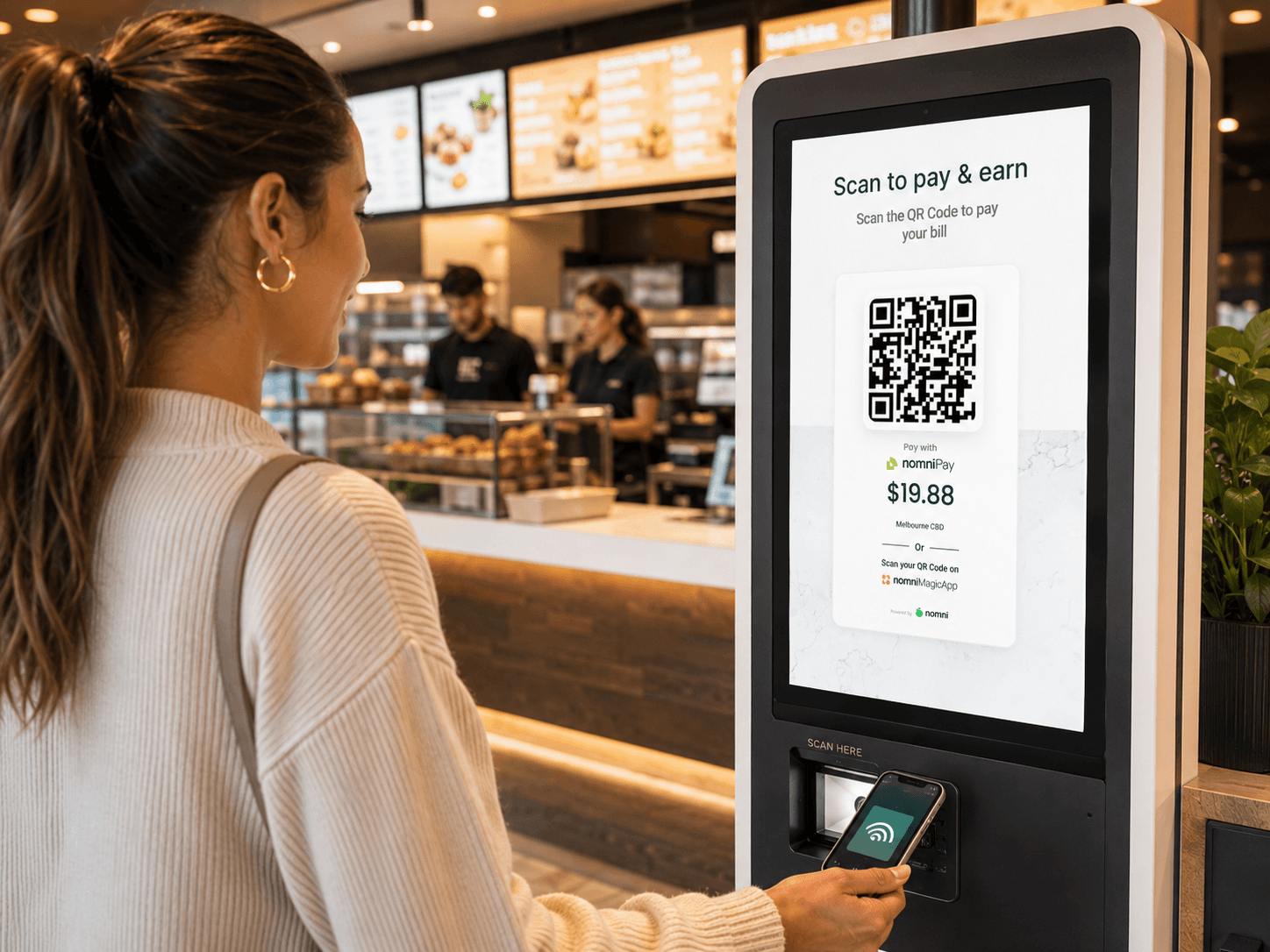
Customers earn points and redeem rewards at the kiosk inside the same flow as ordering and paying, with no separate scan and no app. Connect Nomni Loyalty, and a single tap on the kiosk's NFC reader can carry both the payment and the loyalty redemption at once. The built-in 2D scanner handles QR vouchers and reward codes the same way.
Points accrue on payment, and existing rewards are right there to burn before checkout. The friction you're removing is the whole point: loyalty that lives in a separate app, or on a card someone left at home, is loyalty most people skip in a queue. Inside the order, taking part stops being a decision the customer has to make.
The one most operators haven't switched on: enrolment at the kiosk
Most operators run loyalty somewhere in their stack, but never wired enrolment into the kiosk, which leaves the highest-leverage, lowest-effort feature switched off. Earn-and-redeem only rewards people who are already members. Watch the lunch rush, and most kiosk orders are anonymous: order placed, payment taken, customer gone, no record of who they were. Every one of those unidentified transactions is a customer you can never market to.
Nomni Connect closes that gap, and it doesn't care how the customer paid. Cash, card, tap, or QR: at the end of any order, Connect shows that customer the exact rewards they've just earned on what they bought, member or not. To claim them, they scan and sign up in seconds, no app download, off the integrated receipt printer's QR or straight from the kiosk screen. The moment they claim, that order becomes theirs: an anonymous ticket turns into a known profile with purchase history attached, flowing straight into Nomni Marketing.
It works because it asks nothing extra of the customer or your staff. Nomni's data shows how fast it compounds: of roughly 18,000 customers issued a reward through Connect, about 22% made their first-ever purchase and joined the program in the same step, and rewarded customers were around 28% more likely to return and convert within 30 days. That engine sits under your kiosk already. Enabling it costs nothing, and it's the line between a transaction and a customer.
The kiosk isn't the advantage. The configuration is. Pull up your current setup and check which of these five are live, and which are sitting dark and quietly costing you. Talk to Nomni →
A kiosk doesn't lift sales because it's a touchscreen. It lifts sales because it runs the same upsell on every order, never gets embarrassed, and never gets too slammed to ask. Researchers at the University of Hamburg measured this across real transaction data from 20 restaurants and found that customers spend roughly 14 to 16% more when ordering at a kiosk than at the counter. The lift is real, but only if the kiosk is configured to earn it. Here's what actually moves the number, feature by feature, plus the one most operators still have switched off.
1. Upsell prompts that fire at item and basket level
The upsell is where order value actually moves, and the kiosk runs it on every single ticket from a list you control centrally. Here is how it works in practice. You flag the items you want to move as "Popular" in the master POS, switch Upselling on at the self-ordering kiosk, and those items surface as recommendations while the customer orders, with prompts configurable at item and basket stages and a suggestion at checkout before they pay.
That central control is the point. Change what you are pushing this week, whether it is a slow-moving dessert, a new side, or the combo you want to shift, and it updates across every kiosk at once. You are not relying on each unit or each staff member to remember the upsell.
The Hamburg researchers traced the lift to two things working together: the kiosk applies the same cross-sell logic on every order, and customers order more freely when they don't feel watched across a counter. A server skips the upsell when the line is six deep. The kiosk never skips it.
2. One menu that updates across kiosk, POS, and online at once
Change a price, add an item, or launch a promo once, and it pushes to the kiosk, the POS, and online ordering at the same time, with no separate kiosk menu to maintain. Nomni's unified menu management runs the kiosk off the same menu source as every other channel, so nothing drifts out of step with the counter.
Updates land via silent over-the-air push, meaning menus, pricing, promos, and themes change without a site visit or an IT ticket. Real-time inventory sync is often overlooked: when an item runs out, it disappears from the kiosk instantly, so no one orders, pays for, and then gets refunded on a dish you can't make, and no one stalls the line hunting for a sold-out item. More on running this across sites: effortless menu management for multi-venue restaurants.
3. Offline mode, because a stalled kiosk costs you twice
When the venue's internet drops, the kiosk keeps taking orders and, with Nomni Pay, keeps processing payments, then reconciles everything once the connection returns. The reason it can is architectural. The kiosk runs against the in-venue master POS over the local network instead of making a round trip to the cloud for every order, so a dropped uplink doesn't halt service. The connectivity stack backs that up: wired Gigabit Ethernet or dual-band Wi-Fi in normal operation, with automatic 4G failover through Nomni Pay so card payments keep clearing. Orders placed during the outage hold in a local queue and sync the moment you're back online.
This matters more than uptime for its own sake. A frozen kiosk during a Friday rush doesn't just stall one order; it backs up the line, and the line is where revenue quietly leaks. Researchers at Temple University, publishing in the Journal of Hospitality and Tourism Research, ran three experiments and found that when a queue forms behind a kiosk, customers feel time pressure, order less, default to familiar items, and rush to finish. Read alongside the Hamburg result, the takeaway is blunt: your speed features and your spend features are the same features.
4. Loyalty that earns and redeems inside the order
Customers earn points and redeem rewards at the kiosk inside the same flow as ordering and paying, with no separate scan and no app. Connect Nomni Loyalty, and a single tap on the kiosk's NFC reader can carry both the payment and the loyalty redemption at once. The built-in 2D scanner handles QR vouchers and reward codes the same way.
Points accrue on payment, and existing rewards are right there to burn before checkout. The friction you're removing is the whole point: loyalty that lives in a separate app, or on a card someone left at home, is loyalty most people skip in a queue. Inside the order, taking part stops being a decision the customer has to make.
The one most operators haven't switched on: enrolment at the kiosk
Most operators run loyalty somewhere in their stack, but never wired enrolment into the kiosk, which leaves the highest-leverage, lowest-effort feature switched off. Earn-and-redeem only rewards people who are already members. Watch the lunch rush, and most kiosk orders are anonymous: order placed, payment taken, customer gone, no record of who they were. Every one of those unidentified transactions is a customer you can never market to.
Nomni Connect closes that gap, and it doesn't care how the customer paid. Cash, card, tap, or QR: at the end of any order, Connect shows that customer the exact rewards they've just earned on what they bought, member or not. To claim them, they scan and sign up in seconds, no app download, off the integrated receipt printer's QR or straight from the kiosk screen. The moment they claim, that order becomes theirs: an anonymous ticket turns into a known profile with purchase history attached, flowing straight into Nomni Marketing.
It works because it asks nothing extra of the customer or your staff. Nomni's data shows how fast it compounds: of roughly 18,000 customers issued a reward through Connect, about 22% made their first-ever purchase and joined the program in the same step, and rewarded customers were around 28% more likely to return and convert within 30 days. That engine sits under your kiosk already. Enabling it costs nothing, and it's the line between a transaction and a customer.
The kiosk isn't the advantage. The configuration is. Pull up your current setup and check which of these five are live, and which are sitting dark and quietly costing you. Talk to Nomni →
Nomni is the first complete hospitality system that works for you. Loved by over 35,000 venues across Asia Pacific and used by tens of millions of diners and operators annually. To see how Nomni can work for you, visit Nomni.ai
Nomni is the first complete hospitality system that works for you. Loved by over 35,000 venues across Asia Pacific and used by tens of millions of diners and operators annually. To see how Nomni can work for you, visit Nomni.ai
Share this post
Share this post
You might also like
You might also like
You might also like


Browse by category
Browse by category

SUBSCRIBE FOR FREE
Get proven ideas to boost covers, spend and repeat visits.
SUBSCRIBE FOR FREE
Get proven ideas to boost covers, spend and repeat visits.
SUBSCRIBE FOR FREE
Get proven ideas to boost covers, spend and repeat visits.
SUBSCRIBE FOR FREE
Get proven ideas to boost covers, spend and repeat visits.
MAGIC APPS
VENUES
RESOURCES
MAGIC APPS
VENUES
RESOURCES
MAGIC APPS
VENUES
RESOURCES
Welcome to Nomni, a new day for hospitality, take back control. Learn more here.

Welcome to Nomni, a new day for hospitality, take back control. Learn more here.
Welcome to Nomni, a new day for hospitality, take back control. Learn more here.
Welcome to Nomni, a new day for hospitality, take back control. Learn more here.