
point-of-sales
point-of-sales
Modifiers Aren't Just for Customisation. They're for Margin.
Modifiers Aren't Just for Customisation. They're for Margin.
Modifiers Aren't Just for Customisation. They're for Margin.
Ask most operators what modifiers are for and they'll say customisation. That's only half the story — variants are one of the most direct levers you have on margin. Here's how to find the gaps your data is quietly hiding.
Ask most operators what modifiers are for and they'll say customisation. That's only half the story — variants are one of the most direct levers you have on margin. Here's how to find the gaps your data is quietly hiding.
Written by

Nomni
The ultimate hospo solution
Ask most restaurant operators what modifiers are for and they'll say the same thing: customisation. Let customers have oat milk instead of full cream. No onion, extra sauce. It's a hospitality thing. A customer experience thing.
That's true. But it's only half the story. Modifiers and variants are also one of the most direct levers you have on revenue and margin, and most operators are either underusing them, mis-pricing them, or not tracking them at all.
What your variant data is actually telling you
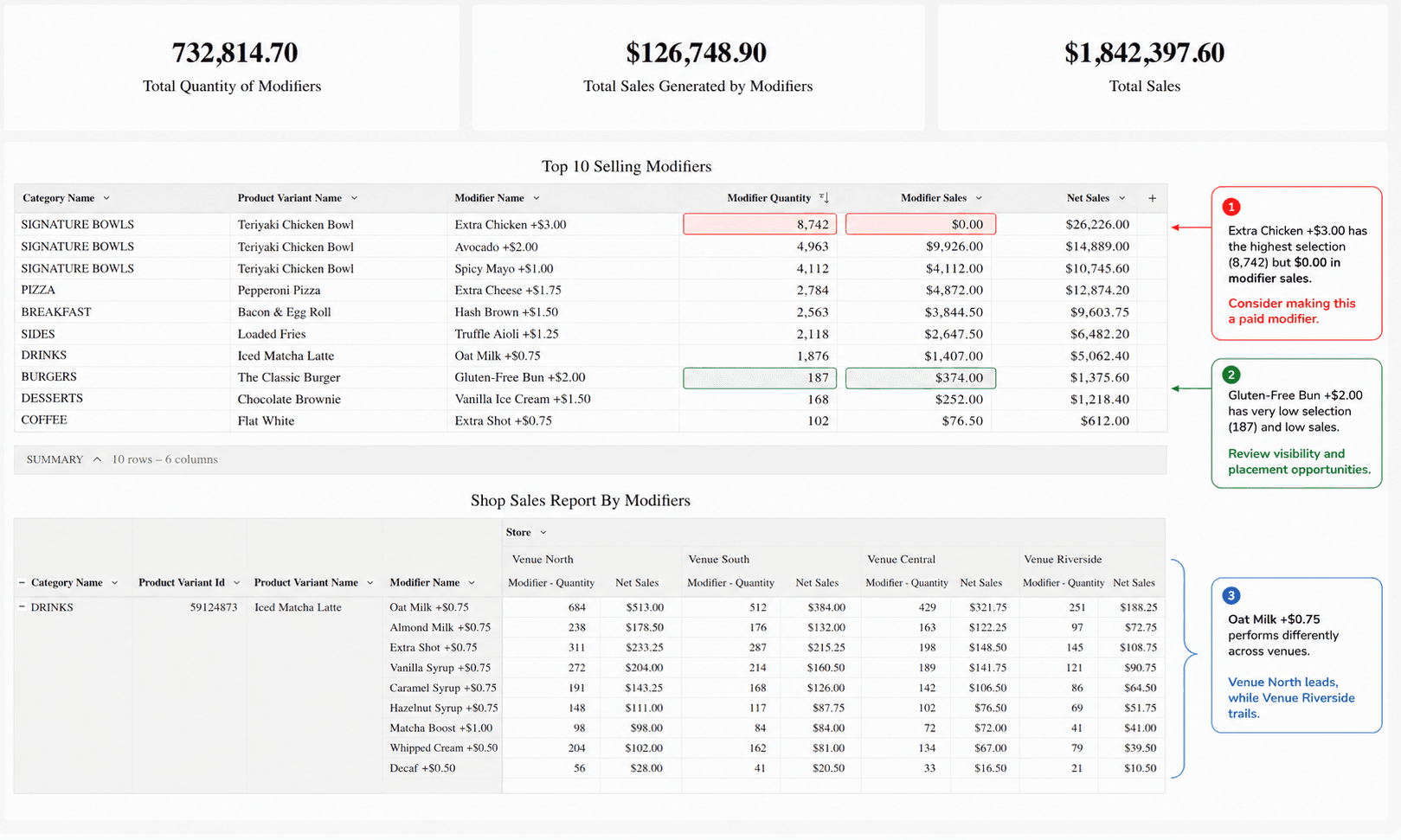
Pull your Sales by Modifier report on Nomni Insights and look at three columns together: modifier quantity, modifier sales, and net sales. The relationships between them tend to surface problems you'd never find otherwise.
Watch for these signals:
A high-volume variant sitting at $0 in sales: ask whether this should be a paid selection. Oat milk has a real cost, and if it's not set up as a paid selection, you're absorbing that cost on every order where it's chosen
A paid variant with near-zero selection rate: before assuming customers don't want it, check where it sits in the modifier group on your POS and whether it's actually visible at the point of order
The same variant performing very differently across your venues: same menu, same pricing, different results. That's almost always a staff behaviour gap, not a customer preference one
Your top-selling dish with no paid variants attached to it at all: a missed opportunity to boost margin
None of these announce themselves as problems. They just drag on your average order value and food cost percentage until you go looking. Here’s a sample report from Nomni Insights that will make it easier for you to understand what to look for.
From Customisation to Conversion: Making Variants Work at the POS
Identifying gaps with your data is step one. The next is making sure your POS is actually doing the work for you.
The difference between a verbal "anything else?" and a variant prompt built into the order flow is the difference between hoping an upsell happens and making it systematic. A well-built modifier group surfaces at every single order, across every shift, without relying on anyone to remember to ask.
When a customer orders a burger bowl and the POS immediately surfaces "add extra protein +$4 / add halloumi +$3", that's the setup doing its job. Miss that configuration and the prompt never happens, across every order, every shift, for as long as the gap sits there.
The product variant setup on Nomni POS gives you full control over this: which variants attach to which products, required versus optional, selection limits, and display order on screen. You can also build combos using variants (bundling items at a set price) which is one of the cleaner ways to lift average order value without touching your core menu.
Impact IRL: An operator with four locations pulls their Sales by Modifier report and finds their "add halloumi +$4" variant is converting at 18% at one venue and under 5% at the others. Same menu, same pricing. When they checked the POS setup, the variant is buried fourth in an optional group at three of the four locations. They reordered it to appear first and make it a prompted selection. Within a few weeks, conversion at the underperforming venues catches up significantly. Moving from under 5% to closer to 15% conversion on a $4 variant across hundreds of orders a week came from a configuration change, not a menu change.
💡Running multiple venues? Variant rules can be configured once and pushed across all sites. When you find something that works at one location, rolling it out everywhere takes minutes, not an afternoon at each terminal.
Do you actually know what your variants cost to make?
Most operators price variants on gut feel or by benchmarking competitors. That might land you in the right ballpark, but without knowing your actual cost per serve, and how that cost moves when supplier prices shift, you're making margin decisions blind.
This is where building your recipes in Nomni Procure changes the picture. Every ingredient in every dish has a cost against it, drawn from your actual invoices and updated as prices change. And it works at a level of granularity most operators haven't experienced before. Nomni Procure shows you the cost per portion per ingredient, so you can see exactly which component is doing the damage on any given dish or variant.
Take a fresh fruit add-on on a granola bowl. You might know the dish runs at roughly 23% food cost overall and feel fine about that. But drill into the cost per portion breakdown and you might find that the strawberries alone account for over a third of the total recipe cost. If you're charging $2.50 for an extra fruit variant, that's a very different pricing conversation than if you'd never looked.
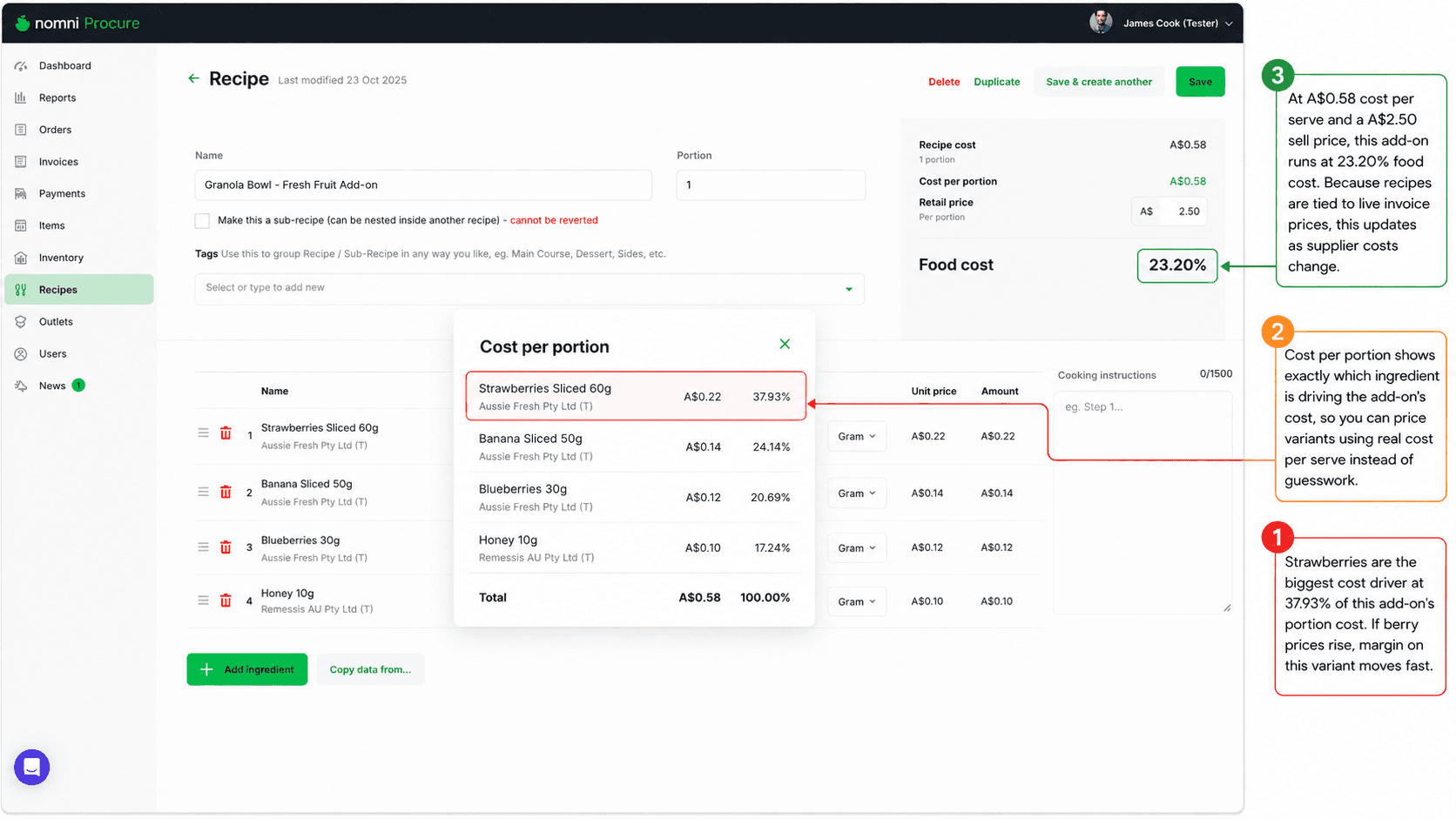
Because Nomni Procure recipes are tied to your live invoice prices, not a static snapshot you update manually, the numbers move when your costs move. If your supplier puts chicken up 15%, that flows through to every dish and every variant containing chicken automatically. You don't need to recost your menu every time a price changes. The recipes do it for you.
Impact IRL: A café group has been charging $0.70 for an oat milk surcharge, a number they set when they opened and never revisited. Ingredient costs have shifted since then. When they map the oat milk variant to its recipe in Nomni Procure, the actual cost per serve has crept up to $0.90. Small gap on any single coffee. Across three venues doing 400+ oat milk coffees a day, it compounds into something worth fixing. They reprice to $1.10, keep all the volume, and the margin gap closes.
When your costs don't match your sales, look at your variants
Real cost data per variant is valuable on its own. But it becomes a proper diagnostic tool when it's mapped against your actual sales.
The Theoretical COGS report in Nomni Procure takes your Nomni POS sales data, maps it against your recipes, and tells you what your cost of goods should have been for any date range. When actual costs run above the theoretical prediction, something is off. Wastage and portioning are the usual suspects, but variants are worth checking too.
Imagine a QSR group introduces a house-made sriracha aioli at one of their venues. It's popular, staff start applying it across several dishes, and it gets added to the menu as a sauce option. But because it was set up in a hurry, it goes in as a $0 selection with no recipe mapping. Months later, that venue's Theoretical COGS is running above prediction and the variance traces back to condiment ingredients. When they dig into the setup, the aioli has no cost or revenue attached to it in the system. They build it as a sub-recipe in Nomni Procure, map it to a new paid variant in POS, and both the cost and the revenue start showing up where they should.
This is the kind of gap that's almost impossible to catch without integrated systems. The ingredient spend sits in procurement while the sales data sits in the POS. Without the two talking to each other and mapping against recipes, the variance just compounds over time.
Run this audit once a quarter
Modifiers and variants are the part of the menu most operators treat as an afterthought. The ones who set up deliberately, price on real data and review regularly tend to find margin in places everyone else has stopped looking.
Here’s a simple audit framework you can use to stay on top of your game.
Step | What to look for | Where |
Read the data | High-volume $0 variants that should be paid. Low-converting paid variants. Performance gaps across venues. | Nomni Insights — Sales by Modifier |
Check your costs | Does your variant pricing hold up against actual ingredient costs? What happens to margin when supplier prices move? | Nomni Procure — Recipes + Theoretical COGS |
Audit the setup | Are paid variants attached to the right products, visible, and prompting correctly? Any variants applied informally that aren't in the system? | Nomni POS — Product Variants |
Make one change | Reprice, reposition, or formalise one variant based on what you found. Watch it in the next cycle. | Nomni POS |
The Margin Is Already There, You Just Have to Find It
Most operators don't need a new menu or a price increase to move the needle on margin. They need a clearer picture of what's already happening at the modifier level, and the right setup to make sure it's working the way it should be.
This only works the way it should when your POS and procurement are integrated. The data flows automatically, and gaps surface on their own rather than compounding quietly for months.
The tools to do this are already part of Nomni One. The Sales by Modifier report, recipe costing in Nomni Procure, and the Theoretical COGS report are all built to surface exactly these gaps. It's a matter of knowing where to look and acting on what you find.
If you're not sure where to start or aren’t on Nomni One yet, book a call with the Nomni team, and we’ll walk you through it.
Already on Nomni One? Get started yourself:
Set up product variants on Nomni POS → Full setup guide
Build your recipes in Nomni Procure → Recipes feature guide
Understand your theoretical costs → TCOGS report guide
Ask most restaurant operators what modifiers are for and they'll say the same thing: customisation. Let customers have oat milk instead of full cream. No onion, extra sauce. It's a hospitality thing. A customer experience thing.
That's true. But it's only half the story. Modifiers and variants are also one of the most direct levers you have on revenue and margin, and most operators are either underusing them, mis-pricing them, or not tracking them at all.
What your variant data is actually telling you
Pull your Sales by Modifier report on Nomni Insights and look at three columns together: modifier quantity, modifier sales, and net sales. The relationships between them tend to surface problems you'd never find otherwise.
Watch for these signals:
A high-volume variant sitting at $0 in sales: ask whether this should be a paid selection. Oat milk has a real cost, and if it's not set up as a paid selection, you're absorbing that cost on every order where it's chosen
A paid variant with near-zero selection rate: before assuming customers don't want it, check where it sits in the modifier group on your POS and whether it's actually visible at the point of order
The same variant performing very differently across your venues: same menu, same pricing, different results. That's almost always a staff behaviour gap, not a customer preference one
Your top-selling dish with no paid variants attached to it at all: a missed opportunity to boost margin
None of these announce themselves as problems. They just drag on your average order value and food cost percentage until you go looking. Here’s a sample report from Nomni Insights that will make it easier for you to understand what to look for.
From Customisation to Conversion: Making Variants Work at the POS
Identifying gaps with your data is step one. The next is making sure your POS is actually doing the work for you.
The difference between a verbal "anything else?" and a variant prompt built into the order flow is the difference between hoping an upsell happens and making it systematic. A well-built modifier group surfaces at every single order, across every shift, without relying on anyone to remember to ask.
When a customer orders a burger bowl and the POS immediately surfaces "add extra protein +$4 / add halloumi +$3", that's the setup doing its job. Miss that configuration and the prompt never happens, across every order, every shift, for as long as the gap sits there.
The product variant setup on Nomni POS gives you full control over this: which variants attach to which products, required versus optional, selection limits, and display order on screen. You can also build combos using variants (bundling items at a set price) which is one of the cleaner ways to lift average order value without touching your core menu.
Impact IRL: An operator with four locations pulls their Sales by Modifier report and finds their "add halloumi +$4" variant is converting at 18% at one venue and under 5% at the others. Same menu, same pricing. When they checked the POS setup, the variant is buried fourth in an optional group at three of the four locations. They reordered it to appear first and make it a prompted selection. Within a few weeks, conversion at the underperforming venues catches up significantly. Moving from under 5% to closer to 15% conversion on a $4 variant across hundreds of orders a week came from a configuration change, not a menu change.
💡Running multiple venues? Variant rules can be configured once and pushed across all sites. When you find something that works at one location, rolling it out everywhere takes minutes, not an afternoon at each terminal.
Do you actually know what your variants cost to make?
Most operators price variants on gut feel or by benchmarking competitors. That might land you in the right ballpark, but without knowing your actual cost per serve, and how that cost moves when supplier prices shift, you're making margin decisions blind.
This is where building your recipes in Nomni Procure changes the picture. Every ingredient in every dish has a cost against it, drawn from your actual invoices and updated as prices change. And it works at a level of granularity most operators haven't experienced before. Nomni Procure shows you the cost per portion per ingredient, so you can see exactly which component is doing the damage on any given dish or variant.
Take a fresh fruit add-on on a granola bowl. You might know the dish runs at roughly 23% food cost overall and feel fine about that. But drill into the cost per portion breakdown and you might find that the strawberries alone account for over a third of the total recipe cost. If you're charging $2.50 for an extra fruit variant, that's a very different pricing conversation than if you'd never looked.
Because Nomni Procure recipes are tied to your live invoice prices, not a static snapshot you update manually, the numbers move when your costs move. If your supplier puts chicken up 15%, that flows through to every dish and every variant containing chicken automatically. You don't need to recost your menu every time a price changes. The recipes do it for you.
Impact IRL: A café group has been charging $0.70 for an oat milk surcharge, a number they set when they opened and never revisited. Ingredient costs have shifted since then. When they map the oat milk variant to its recipe in Nomni Procure, the actual cost per serve has crept up to $0.90. Small gap on any single coffee. Across three venues doing 400+ oat milk coffees a day, it compounds into something worth fixing. They reprice to $1.10, keep all the volume, and the margin gap closes.
When your costs don't match your sales, look at your variants
Real cost data per variant is valuable on its own. But it becomes a proper diagnostic tool when it's mapped against your actual sales.
The Theoretical COGS report in Nomni Procure takes your Nomni POS sales data, maps it against your recipes, and tells you what your cost of goods should have been for any date range. When actual costs run above the theoretical prediction, something is off. Wastage and portioning are the usual suspects, but variants are worth checking too.
Imagine a QSR group introduces a house-made sriracha aioli at one of their venues. It's popular, staff start applying it across several dishes, and it gets added to the menu as a sauce option. But because it was set up in a hurry, it goes in as a $0 selection with no recipe mapping. Months later, that venue's Theoretical COGS is running above prediction and the variance traces back to condiment ingredients. When they dig into the setup, the aioli has no cost or revenue attached to it in the system. They build it as a sub-recipe in Nomni Procure, map it to a new paid variant in POS, and both the cost and the revenue start showing up where they should.
This is the kind of gap that's almost impossible to catch without integrated systems. The ingredient spend sits in procurement while the sales data sits in the POS. Without the two talking to each other and mapping against recipes, the variance just compounds over time.
Run this audit once a quarter
Modifiers and variants are the part of the menu most operators treat as an afterthought. The ones who set up deliberately, price on real data and review regularly tend to find margin in places everyone else has stopped looking.
Here’s a simple audit framework you can use to stay on top of your game.
Step | What to look for | Where |
Read the data | High-volume $0 variants that should be paid. Low-converting paid variants. Performance gaps across venues. | Nomni Insights — Sales by Modifier |
Check your costs | Does your variant pricing hold up against actual ingredient costs? What happens to margin when supplier prices move? | Nomni Procure — Recipes + Theoretical COGS |
Audit the setup | Are paid variants attached to the right products, visible, and prompting correctly? Any variants applied informally that aren't in the system? | Nomni POS — Product Variants |
Make one change | Reprice, reposition, or formalise one variant based on what you found. Watch it in the next cycle. | Nomni POS |
The Margin Is Already There, You Just Have to Find It
Most operators don't need a new menu or a price increase to move the needle on margin. They need a clearer picture of what's already happening at the modifier level, and the right setup to make sure it's working the way it should be.
This only works the way it should when your POS and procurement are integrated. The data flows automatically, and gaps surface on their own rather than compounding quietly for months.
The tools to do this are already part of Nomni One. The Sales by Modifier report, recipe costing in Nomni Procure, and the Theoretical COGS report are all built to surface exactly these gaps. It's a matter of knowing where to look and acting on what you find.
If you're not sure where to start or aren’t on Nomni One yet, book a call with the Nomni team, and we’ll walk you through it.
Already on Nomni One? Get started yourself:
Set up product variants on Nomni POS → Full setup guide
Build your recipes in Nomni Procure → Recipes feature guide
Understand your theoretical costs → TCOGS report guide
Nomni is the first complete hospitality system that works for you. Loved by over 35,000 venues across Asia Pacific and used by tens of millions of diners and operators annually. To see how Nomni can work for you, visit Nomni.ai
Nomni is the first complete hospitality system that works for you. Loved by over 35,000 venues across Asia Pacific and used by tens of millions of diners and operators annually. To see how Nomni can work for you, visit Nomni.ai
Share this post
Share this post
You might also like
You might also like
You might also like
Browse by category
Browse by category

SUBSCRIBE FOR FREE
Get proven ideas to boost covers, spend and repeat visits.
SUBSCRIBE FOR FREE
Get proven ideas to boost covers, spend and repeat visits.
SUBSCRIBE FOR FREE
Get proven ideas to boost covers, spend and repeat visits.
SUBSCRIBE FOR FREE
Get proven ideas to boost covers, spend and repeat visits.
MAGIC APPS
VENUES
RESOURCES
MAGIC APPS
VENUES
RESOURCES
MAGIC APPS
VENUES
RESOURCES
Welcome to Nomni, a new day for hospitality, take back control. Learn more here.

Welcome to Nomni, a new day for hospitality, take back control. Learn more here.
Welcome to Nomni, a new day for hospitality, take back control. Learn more here.
Welcome to Nomni, a new day for hospitality, take back control. Learn more here.